
Lean PlanDo manual › Do List
How progress is calculated
Learn how Lean PlanDo calculates planned, actual and expected progress for leaf and summary activities.
Lean PlanDo calculates progress from the bottom of your schedule upwards. Use this page to check how a progress figure was worked out.
Project Settings has a Weighted progress calculation option. With it on, you give each activity a weightage, in a unit you choose when you switch it on (for example man days). Lean PlanDo then also shows weighted progress: the completed weightage of all leaf activities divided by their total weightage. The result shows in an extra Weekly Project Progress (Weight) chart. The duration-based progress below stays as it is.
Leaf and summary activities
In a master schedule, a summary activity has sub activities under it. A leaf activity has no sub activities.
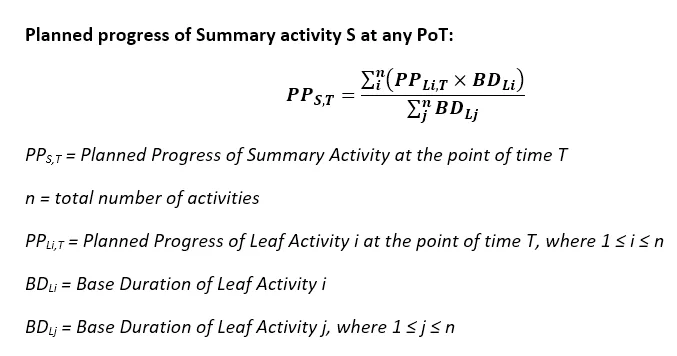
A summary activity's progress comes from the progress of its leaf activities. Lean PlanDo ignores the duration of summary activities, including summary activities inside other summary activities. For every activity, it finds all the lowest-level leaf activities and uses their durations.
Lean PlanDo has two types of progress:
- Planned progress: the amount of work that should be finished at a point in time, according to the base dates (the dates an activity has when the first Lookahead is generated).
- Actual progress: the progress built up from the actual progress updates on the tasks under the leaf activities.
Planned progress
Leaf activity
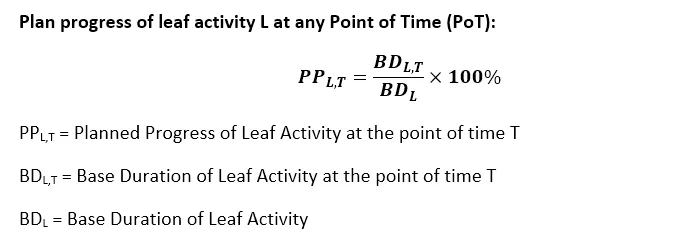
Example: activity A has a base duration of 10 days. On day 4, the planned progress of A is:
(4/10) x 100% = 40%
Summary activity
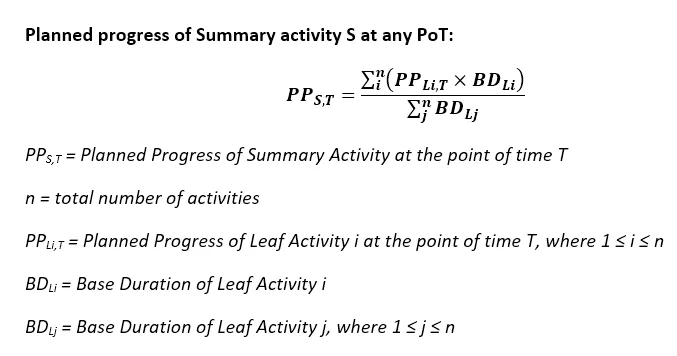
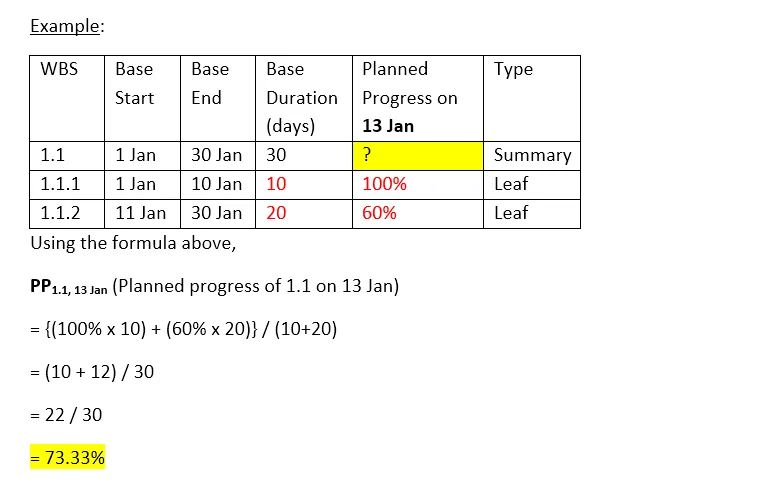
A summary activity's planned progress at any point in time comes from its leaf activities. Each leaf activity is weighted by its base duration.
Actual progress
Tasks
Users enter task progress directly, as a percentage or a quantity. Lean PlanDo converts a quantity into the equivalent percentage. For example:
- Actual progress of Task 1 = 50% (50% entered by the user)
- Actual progress of Task 2 = 8/18 x 100 = 44.4% (8 units entered by the user)
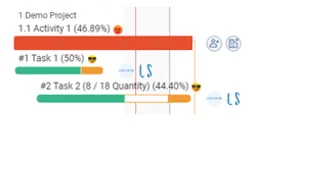
Leaf activities
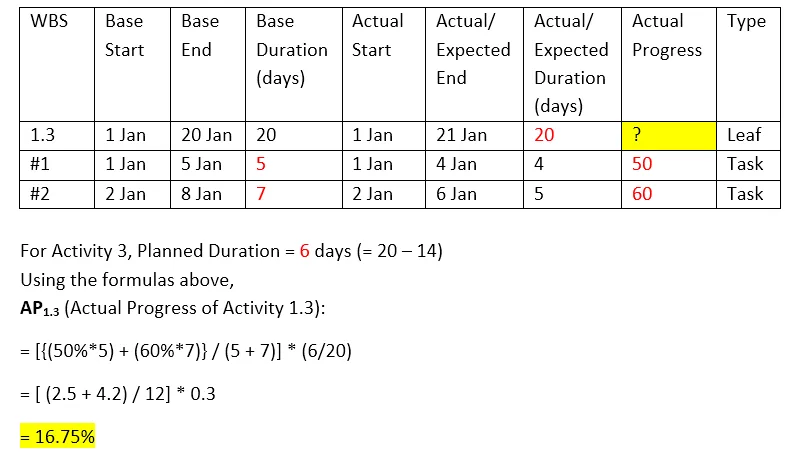
A leaf activity's actual progress comes from the progress of the tasks planned within its planned portion. An activity can be fully planned or partially planned.
Fully planned activity. The planned duration is the whole activity duration.
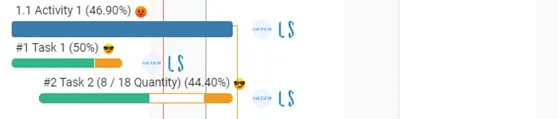
Partially planned activity. Only the first part of the activity is planned out as tasks. The planned duration runs from the start of Task 1 to the end of Task 2.
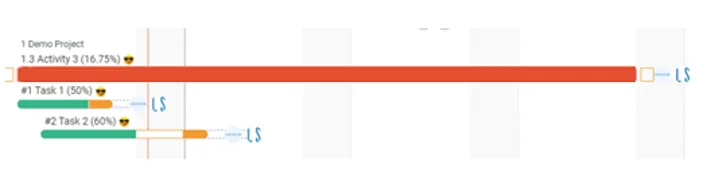
Each task is weighted by its duration over the planned portion of the activity. When you delete a task or activity, Lean PlanDo recalculates the percentages with the same formula.
Example:
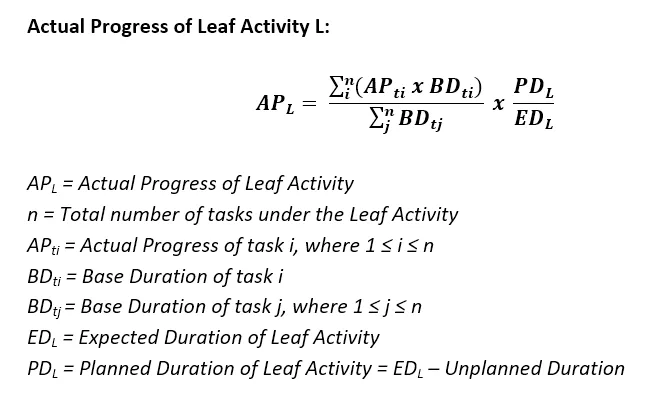
Fully planned activity
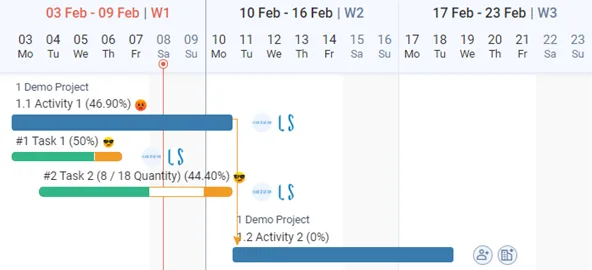
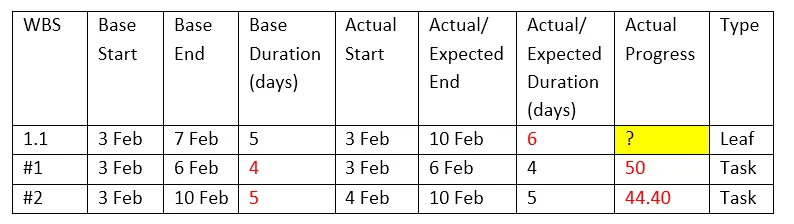
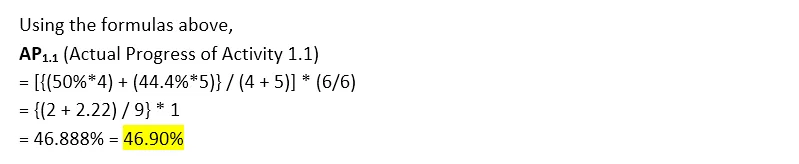
Example:
Partially planned activity
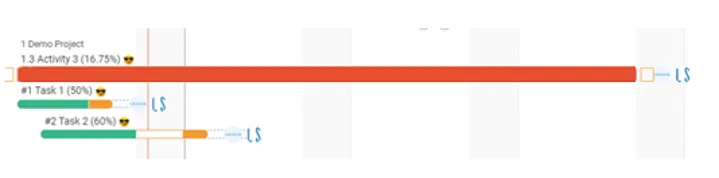
Summary activities
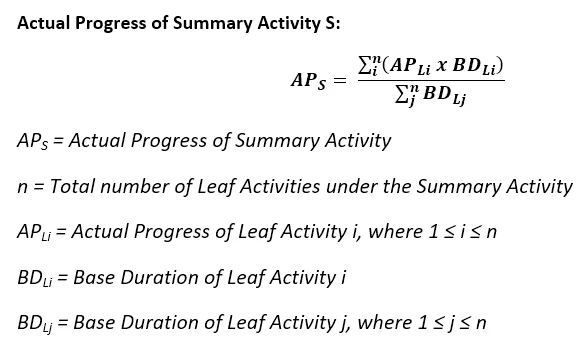
Example:
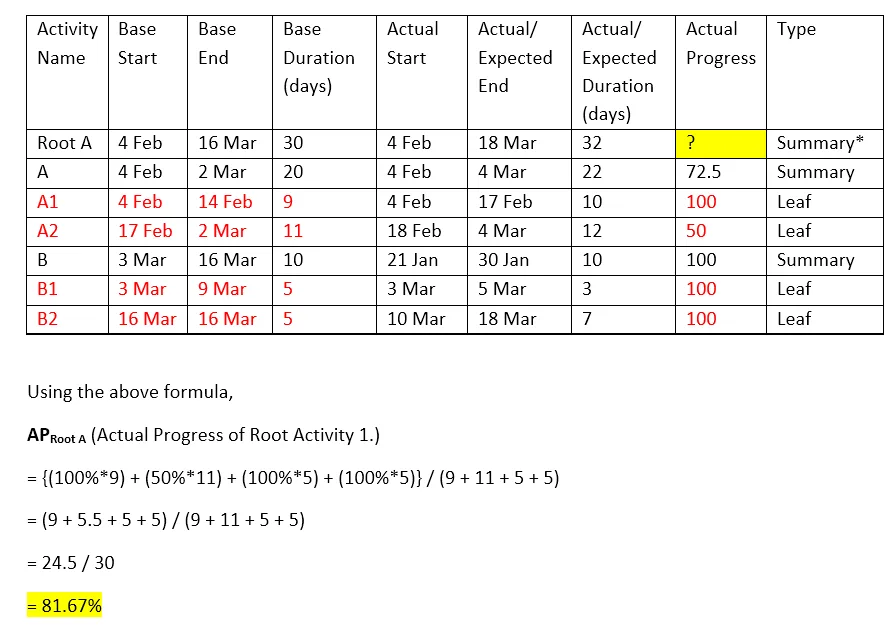
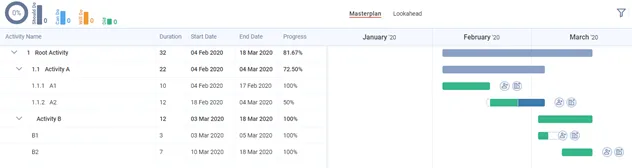
Expected progress
Expected progress uses the expected dates of the activities. The formula is close to the one for actual progress.
For a leaf activity:
Expected Duration = Base Duration x (Expected Progress)
Lean PlanDo works out an activity's expected progress at a given date, here the end date of the Do week (the first week of the Lookahead, where tasks can be committed; it should be the current calendar week):
- Expected end date before the Do week end date: expected progress is 100.
- Expected start date after the Do week end date: expected progress is 0.
- Expected start date before, and expected end date after, the Do week end date: expected progress is (duration from expected start date to Do week end date) / (expected duration of the activity).
Then:
- Add up the expected durations of all leaf activities under a summary activity.
- Divide that sum by the sum of the base durations of all leaf activities under it.
- Repeat this up to the project's overall summary activity. The result is the project's expected progress at that Do week end date.
Last updated 2021-02-08. Part of Do List in the Lean PlanDo manual. Lean PlanDo by Lean Station.